


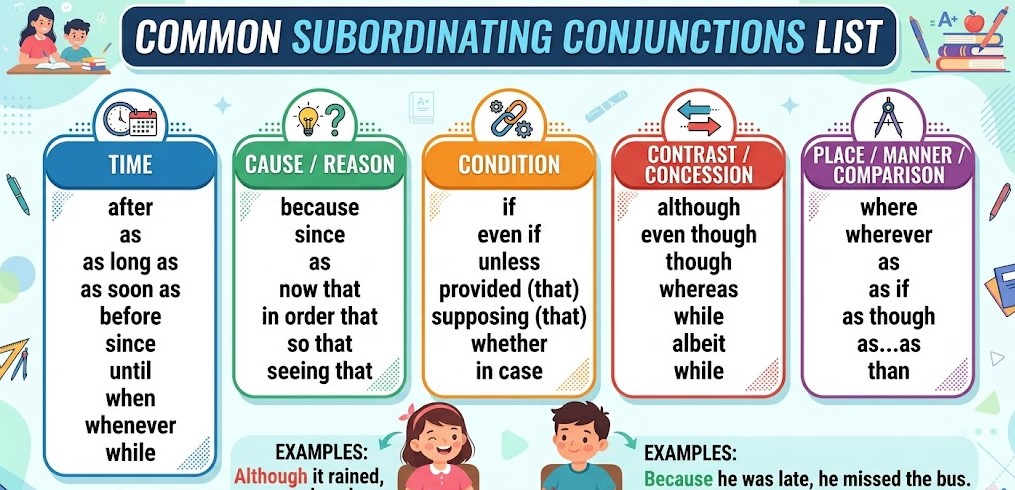
Subordinating conjunctions are important connecting words in English grammar that join a dependent clause to an independent clause, helping to create meaningful and complete sentences. These words show relationships such as time, reason, condition, contrast, and purpose between two ideas. Without subordinating conjunctions, sentences often become short, disconnected, and less expressive. Common examples include because, although, if, when, since, while, before, and after, which are frequently used in everyday communication. A subordinating conjunctions list is essential for learners because it helps them recognize these words and understand how they function in sentence structure. By using subordinating conjunctions correctly, writers can combine ideas smoothly and make their writing more fluent, logical, and professional.
Why Subordinating Conjunctions Are Important in Writing
Subordinating conjunctions play a crucial role in improving sentence clarity and overall writing quality. They allow writers to connect ideas in a way that shows clear relationships between actions, events, or conditions, which makes the text more engaging and easier to understand. For example, instead of writing two simple sentences like “I stayed home. It was raining,” you can combine them using a subordinating conjunction: “I stayed home because it was raining.” This not only improves flow but also adds depth to the meaning. Using a strong subordinating conjunctions list helps writers avoid repetitive sentence structures and enhances readability in essays, reports, articles, and storytelling. In academic and professional writing, proper use of these conjunctions is often linked to better communication skills and higher-quality content.
Complete Subordinating Conjunctions List
A complete subordinating conjunctions list includes a wide range of words that serve different grammatical purposes in English sentences. Some of the most commonly used subordinating conjunctions include: after, although, as, as soon as, because, before, even if, even though, if, in case, since, so that, though, unless, until, when, whenever, where, whereas, and while. These words help connect ideas and show relationships between clauses in a sentence. For instance, “because” shows reason, “when” shows time, and “if” shows condition. Learning this list is extremely helpful for students and writers because it improves both writing accuracy and speaking fluency. The more familiar you become with these conjunctions, the easier it becomes to construct complex and meaningful sentences naturally.
Types of Subordinating Conjunctions
Subordinating conjunctions can be categorized based on the type of relationship they express between clauses. The main types include time, cause and reason, condition, contrast, and place. Time conjunctions such as when, before, after, and while indicate when an action happens. Cause and reason conjunctions like because, since, and as explain why something occurs. Condition conjunctions such as if, unless, and provided that show requirements or conditions. Contrast conjunctions like although, though, and whereas highlight differences between ideas. Place conjunctions such as where and wherever describe location-based relationships. Understanding these categories helps learners use a subordinating conjunctions list more effectively in different writing situations and improves sentence variety and clarity.
Examples of Subordinating Conjunctions in Sentences
Examples are the best way to understand how subordinating conjunctions work in real communication. For instance, “I will go outside when the rain stops” shows time, while “She passed the exam because she studied hard” shows reason. Similarly, “Although he was tired, he continued working” demonstrates contrast, and “If you practice regularly, you will improve” shows condition. These examples clearly show how subordinating conjunctions connect two ideas and make sentences more meaningful. Using a subordinating conjunctions list regularly in writing practice helps learners become more confident in forming complex sentences. It also improves their ability to express thoughts clearly in both academic and everyday contexts.
Common Mistakes to Avoid
Many learners make mistakes when using subordinating conjunctions, especially when forming sentence structures or choosing the correct word. One common mistake is creating sentence fragments by using a dependent clause alone, such as “Because I was tired,” without completing the thought. Another frequent error is misplacing the conjunction, which can make the sentence confusing or unclear. Some learners also overuse simple conjunctions like “and” instead of using a proper subordinating conjunctions list, which limits sentence variety. Additionally, incorrect punctuation placement, especially commas, can change the meaning of a sentence. Avoiding these mistakes helps improve writing accuracy and ensures better communication in both formal and informal contexts.
Tips for Using Subordinating Conjunctions Correctly
To use subordinating conjunctions correctly, it is important to understand the relationship between the clauses you are connecting. Always ensure that a dependent clause is attached to a complete independent clause to form a meaningful sentence. Practice using different conjunctions from a subordinating conjunctions list to improve sentence variety and avoid repetition. Reading high-quality texts can also help you see how experienced writers use these words naturally. Another useful tip is to practice rewriting simple sentences into complex ones using subordinating conjunctions, which strengthens grammar skills over time. Consistent practice will help you become more confident and fluent in both writing and speaking.
Conclusion
Subordinating conjunctions are essential tools in English grammar that help connect ideas and create clear, meaningful sentences. A strong understanding of the subordinating conjunctions list allows writers and learners to express relationships such as time, reason, condition, and contrast more effectively. These words improve sentence flow, enhance writing quality, and make communication more professional and engaging. By learning their types, practicing examples, and avoiding common mistakes, anyone can significantly improve their grammar skills. Mastering subordinating conjunctions is not just about memorizing a list—it is about using them naturally to create better and more powerful sentences.
FAQs
What is a subordinating conjunction?
A subordinating conjunction is a word that connects a dependent clause to an independent clause.
Why are subordinating conjunctions important?
They help show relationships between ideas and improve sentence clarity and structure.
What are some common subordinating conjunctions?
Common ones include because, although, if, when, since, and while.
How can I improve my use of subordinating conjunctions?
Practice writing sentences using different conjunctions and study examples regularly.
For more update visit genius.com.in
